Bells of Steel Competition Kettlebells
Bells of Steel's competition-size bell, logged from the maker's own sheet: one shell size from 4 to 48 kg, a 35 mm handle, a printed tolerance of ±100 to ±200 g and a limited lifetime warranty, at $109.99 for 16 kg on a Black Friday price. All 16 weights were in stock on 25 November 2026. The shell is cast iron, not steel, and the page disagrees with itself on height and on the 8 kg tolerance.
By Matt Brennan, CSCS, head tester
- Sheet checked
- Updated
Affiliate disclosure The buy link on this page may pay us a commission. Commission never changes a score, a rank or a printed con. Full policy.
Verdict
The best-documented kettlebell on this desk. Bells of Steel prints a weight tolerance, a full set of dimensions, the handle and window sizes, and a limited lifetime warranty, and all 16 weights were in stock. It costs more per kilogram than any other fixed bell we could price, the heavy end gets expensive fast, and the sheet has two errors to read around.
The sheet
On paper this is the most complete kettlebell sheet of the four makers we read. Bells of Steel states one shell size at every weight, a 35 mm handle and 60 mm window from 8 kg up, a hollow one-piece casting with no filler, and a weight tolerance of ±100 g on the light bells and ±200 g above. Titan's steel competition bell, by contrast, carries one year. The costs: $6.47 to $6.87 per kg in the middle weights, $489.99 for the 48 kg, and a page that gives two heights and two tolerance splits.
What the maker states
All of this comes from Bells of Steel’s own pages: the Competition Kettlebells product page on its US store and its warranty page, read on 25 November 2026. No bell was on our floor, and none of the figures below is ours.
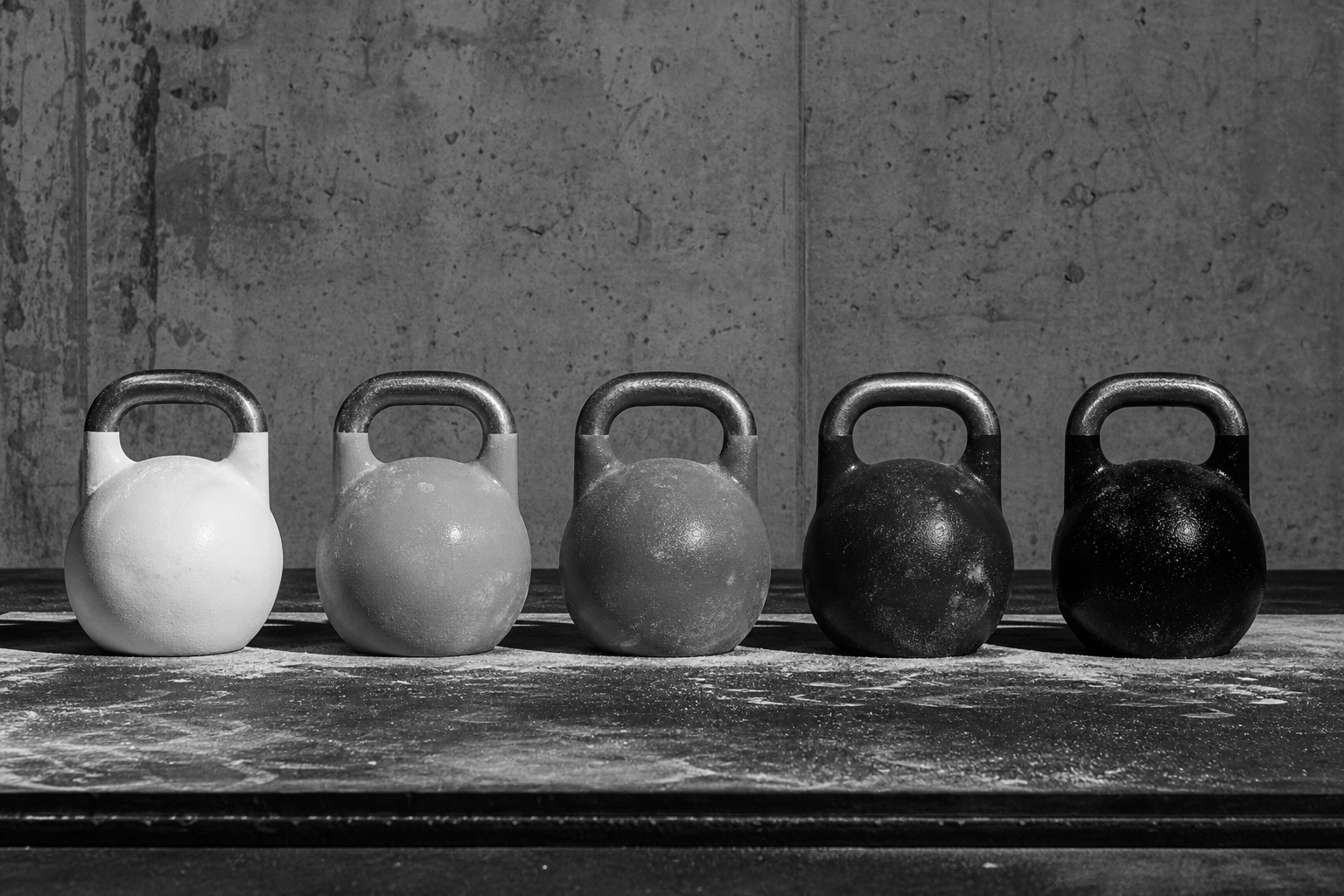
The idea of a competition bell is that the outside never changes. Bells of Steel states it plainly: the same shell from 4 to 48 kg, 8 1/4 in or 210 mm across, with the wall getting thicker as the weight goes up. The handle is 35 mm from 8 kg up, inside a window 60 mm high and 120 mm wide. The 4 and 6 kg bells step down to a 34 mm handle and a 64 mm window, which Bells of Steel says suits beginners and smaller hands.
The material is cast iron, gravity cast as one piece, with a hollow core. The page is emphatic about what is not inside: “No welded handle. No seam. No filler, no shot, nothing loose inside.” The coating is powder coat, the sport colour goes on the shell, and the weight is embossed on the face in kilograms and pounds. Bells of Steel says the line is built to Girevoy Sport Union, IKFF and IUKL sizing.
Then the figure most kettlebell makers leave out. The spec table gives the accuracy as ±100 g on the 4, 6 and 8 kg and ±200 g from 10 to 48 kg. It also says the company’s own powder-coat line runs ±300 g.
Sixteen weights are listed: 4 to 20 kg in 2 kg steps, then 24, 28, 32, 36, 40, 44 and 48 kg. Black Friday prices on the check date, every weight in stock: $49.99 for 4 kg, $74.99 for 8 kg, $93.99 for 12 kg, $109.99 for 16 kg, $129.99 for 20 kg, $164.99 for 24 kg, $206.99 for 32 kg and $489.99 for 48 kg. The sale prices sit 10 to 21% below the list prices shown beside them, and the page gives no end date for the sale. The store advertises free US shipping.
Warranty: limited lifetime on the bell. Bells of Steel’s warranty page limits that to the original purchaser for as long as they own the bell. It excludes cosmetic damage to paint and finishes, and it is void if the product is abused by repeated impact on a rough, aggregate surface or slammed on the ground from overhead.
What to watch
The tolerance, in proportion. ±200 g on a 16 kg bell is 1.25%. On a 32 kg bell it is 0.6%, and on the 48 kg, 0.4%. At the light end the band tightens to ±100 g, but on a 4 kg bell that is still 2.5%. None of it matters for one bell and a timer. It matters for pairs: two 24 kg bells at opposite ends of the band are 400 g apart. REP and Titan print no figure, and the only Kettlebell Kings figure we found, 0.3 kg, sits on an older page. That is why build scores highest here.
Two errors on one page. The product details give the height as 11 in, 280 mm. The spec table and a feature block give 11 1/8 in and print 210 mm beside it, which is the width figure repeated; 11 1/8 in is about 283 mm. The tolerance split also moves: the spec table puts the 8 kg in the ±100 g band, while the product details put it at ±200 g. Read the tighter figure as a hope and the looser one as the promise.
Cast iron, not steel. Titan’s competition bell is steel, and most competition bells are. Bells of Steel’s is a hollow cast-iron shell under powder coat. The maker states no performance difference and we have none to offer. The practical one is the finish: where powder coat chips, bare iron rusts, and chips are cosmetic damage that the warranty excludes. Store the bells off a concrete floor in a damp garage, and read our handle finish guide before deciding how much chalk to leave on them.
The heavy end costs. Per kilogram the middle of the range is steady, $6.47 to $6.87 from 16 to 32 kg. Above that it climbs: $8.25 at 40 kg and $10.21 at 48 kg. The 48 kg costs $489.99, almost three times the 24 kg. These are sale prices, and the list prices are higher again.
Gaps above 20 kg. There is no 22, 26 or 30 kg. Titan’s steel competition line steps every 2 kg from 8 to 32 kg, which matters to a sport lifter adding reps at one weight before moving up.
The sanctioning claim. Bells of Steel says the line meets GSU, IKFF and IUKL sizing and calls the 35 mm handle the required international competition size. We have not checked that against the federations’ own rules, and the page cites none.
Who it is for
Lifters who want every bell in the rack to sit the same way on the forearm: anyone training cleans, snatches and jerks, anyone doing doubles, and anyone who intends to compete. It also suits a buyer who simply wants a number on the sheet. If two bells must match, this is the line that tells you how closely.
It is not the budget pick. REP’s cast-iron 16 kg is $79.99 against $109.99 here, and Titan’s steel competition 16 kg is $103.97, though on a one-year warranty. Nor is it the cheap way to own a very heavy bell: REP sells a 48 kg for $209.99.
The verdict
Eight point eight. Build scores the stated tolerance, material and warranty, and value scores the price per kilogram against that build. Use scores practicality and stock on the day we checked prices; every figure comes from the maker’s sheet, so these scores rank documents, not bells on our floor.
Build gets 9.1: a printed tolerance, full dimensions, a one-piece casting and a lifetime term, docked for a cast-iron shell whose finish the warranty does not cover and for a sheet with two errors. Value gets 8.1: $6.87 per kg at 16 and 24 kg is the most of any fixed bell we could price, and the heavy end runs past $10. Use gets 9.1: 16 weights from 4 to 48 kg, all in stock, free US shipping and one shell size throughout.
Buy the weights you need now. The shell will not change when you move up.
Specs and measurements
| Measure | Value |
|---|---|
| Material | Cast iron, gravity cast in one piece, hollow core, no filler, stated |
| Coating | Powder coat, sport colour on the shell, stated |
| Height | 11 in, 280 mm, stated in the product details; 11 1/8 in in the spec table |
| Body diameter | 8 1/4 in, 210 mm, stated |
| Handle diameter | 35 mm from 8 kg up; 34 mm on 4 and 6 kg, stated |
| Window | 60 mm high from 8 kg up, 64 mm on 4 and 6 kg; 120 mm wide, stated |
| Weight tolerance | ±100 g on 4, 6 and 8 kg, ±200 g on 10 to 48 kg, stated in the spec table |
| Weights | 4 to 20 kg in 2 kg steps, then 24 to 48 kg in 4 kg steps, stated |
| Markings | Kilograms and pounds embossed on the face, stated |
| Warranty | Limited lifetime on the bell, original purchaser; cosmetic damage to paint and finishes excluded |
| Price per kg | $6.87 at 16 kg, $6.87 at 24 kg, $6.47 at 32 kg, $10.21 at 48 kg |
| Stock | All 16 weights in stock, checked 2026-11-25 |
Pros and cons
Pros
- Printed tolerance: ±100 g on the light bells, ±200 g up to 48 kg
- Limited lifetime warranty on the bell
- One shell size and a 35 mm handle from 8 to 48 kg
- All 16 weights, 4 to 48 kg, in stock with free US shipping
Cons
- $6.87 per kg at 16 and 24 kg; $489.99 for the 48 kg
- Cast-iron shell under powder coat; finish damage is excluded from the warranty
- Page states the height as both 280 and 210 mm, and puts the 8 kg in two tolerance bands
- No 22, 26 or 30 kg
How we scored
The unit went through the timed pass and the price was checked against the seller, then scored against the limits we hold all kettlebells to. The scores come from those numbers, not from the box.
- Mass against nominal ± 1.0% Desk limit
- Handle diameter, competition bells 33 mm ± 0.5 mm IKSFA
Written by
Head tester
Fifteen years coaching powerlifting and strongman. Writes the load protocols and the safety rules, and stops a test when one of them says so.
How Matt tests →Spotted a wrong number? Tell the desk. Fixed within two business days and logged on the corrections page.