Guide · 9 min read
Rust prevention in an unheated garage
Steel rusts while it is wet, and an unheated garage puts water on cold steel every humid morning. Dew point, the corrosion threshold in ISO 12944-2, what bar finishes cost, what the makers' warranties say about rust, and the oils and dehumidifiers worth their price, checked on 25 November 2026.
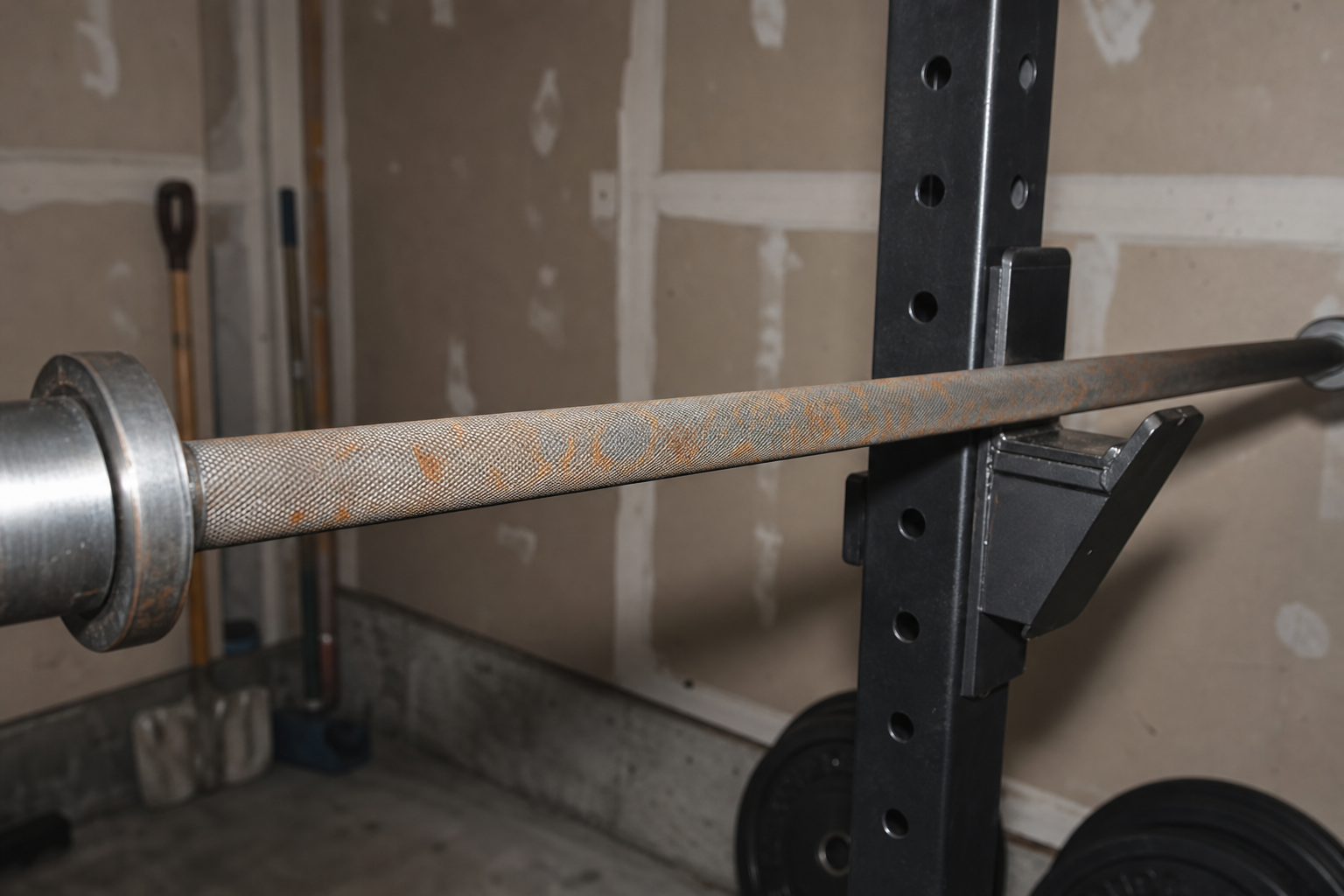
Why cold steel sweats
The National Weather Service defines dew point as “the temperature to which air must be cooled in order to reach saturation”. Any surface colder than the dew point of the air around it collects water.
An unheated garage builds that situation daily. Steel loses heat overnight and warms slowly. Open the door on a warm, humid morning and the air that comes in can have a dew point above the temperature of the bar. Water forms on the knurl, the J-cups and the plates, and you will often not see it.
Corrosion engineers put a number on the risk. ISO 12944-2, which adapts the definition from ISO 9223, counts “time of wetness” as the hours when relative humidity is above 80% while the temperature is above 0 °C. Those are the hours when atmospheric corrosion runs. Your job is to cut them.
Chalk and sweat make it worse. American Barbell’s care page says plainly: “Rust also will form under sealed or caked on chalk.”
Buy the finish for the room
The cheapest rust prevention is paid for once, at checkout. These are the prices for finish options on two bars sold on 25 November.
| Bar | Finish | Price |
|---|---|---|
| Bells of Steel Utility Bar | Black zinc | $199.99 |
| Bells of Steel Utility Bar | Cerakote | $229.99 |
| REP Black Diamond Power Bar | Cerakote shaft, Duracoat sleeves | $260.99 |
| REP Black Diamond Power Bar | Stainless shaft, hard chrome sleeves | $305.99 |
| REP Black Diamond Power Bar | Full stainless | $350.99 |
Bells of Steel describes its Cerakote as “far more resistant to humidity and corrosion”. REP says its stainless went through “extensive salt-spray testing”. Rogue’s care page ranks finishes by how much oil they need: stainless and Cerakote usually need brushing only, zinc an occasional light oil, and black oxide frequent oiling. Bare steel, with no finish at all, needs more care than any of them.
In a humid, unheated garage, the $30 step from zinc to Cerakote on the Bells of Steel bar is the cheapest upgrade on this page. Full stainless costs $90 more than Cerakote on the REP bar and needs the least attention of all.
What the warranty will not do
Read the warranty before you count on it.
- Texas Power Bars is the only maker we found that names rust: “oxidation, surface rust, discoloration, and normal knurl wear are not covered under warranty.”
- REP can void coverage for damage from “negligent use, maintenance, storage (i.e. storing outside)”, and adds: “Warranty does not apply to basic barbell maintenance.”
- Bells of Steel: “Warranty does not apply to barbells that need maintenance.”
- Titan excludes “Improper assembly, installation and/or maintenance”, on a one-year warranty.
None of these will replace a bar because it rusted in a garage. Maintenance is the owner’s job, in writing.
Control the air
Keep the door shut on humid days. The garage door is the largest opening for wet air. Open it to move the car, not to ventilate.
Hang a hygrometer. A logging model shows how many hours a day the garage spends above the 80% line. Eleiko’s care page asks for bars kept dry and at 63 to 81 °F; an unheated garage will not hold that range, which is why the other steps matter.
Check the dehumidifier’s operating range. A dehumidifier rated only for warm rooms does little in a cold garage. Two stated examples:
- AlorAir Sentinel HD55, compressor type: operating range stated as 33.8 to 104 °F in its specs, though a feature bullet on the same page says 36 °F; 53 pints a day at AHAM test conditions; $509.71 on the maker’s store.
- Meaco DD8L Zambezi, desiccant type: rated 1 to 37 °C. It is a UK product, listed at £199.99 and out of stock on 25 November; we include it as an example of the type, not a recommendation.
If the unit takes a drain hose, run it to a floor drain or outside, so it keeps working when nobody empties the bucket.
Keep a film on bare steel
On a bar you grip, oil is the protection. Rogue’s cleaning guide says to remove chalk “using a nylon bristle brush” and to “apply a light coat of 3-In-One Multipurpose Oil across the bar shaft”. The maker of 3-IN-ONE says the oil “lubricates moving parts, penetrates rust, and protects tools and equipment”. Rogue’s care page adds the test that matters: “The bar should feel dry, not slick.”
How often depends on the room. Rogue says weekly in high-use or humid gyms and monthly in home gyms or dry climates; REP says quarterly for home gyms, “or more frequently, if you want”. An unheated garage is the humid case.
For steel you do not grip, a longer-lasting film works. WD-40 Specialist Corrosion Inhibitor is stated to protect “up to 1 year outdoors or 2 years indoors”, based on salt-spray and humidity-chamber tests, and WD-40 warns against prolonged contact with rubber, so keep it off bumpers and mats. Boeshield T-9 describes a “waxy, waterproof film” and suggests reapplying every 6 to 12 months for stored items. Use these on spare iron plates, collars, pins and rack hardware.
Keep steel off the slab
Concrete stays cold and damp longer than the air. Bars go on a rack, plates on horns or a tree, collars on a hook. American Barbell recommends storing bars on “a horizontal rack (not vertical)”. See plate storage for options and capacities.
We would not wrap a bar in plastic. A tight cover holds condensation against the steel.
Light rust, caught early
Brush it before you oil it. Every maker that gives brush advice says nylon for coated bars. On bare steel, Bells of Steel says to clean with Simple Green and a BBQ brush, wipe with a microfiber cloth and lightly oil, and Texas Power Bars allows a steel-bristle brush. American Barbell recommends a stainless steel brush for stainless and hard chrome. The barbell care guide sets out each maker’s routine.
Checklist
- Door shut on humid days; hygrometer on the wall.
- Dehumidifier rated for the garage’s low temperatures, draining itself.
- Chalk brushed off after every session.
- Light oil on bare and zinc bars, weekly in humid months.
- Corrosion inhibitor on steel you do not grip.
- Nothing stored on the slab.