Guide · 9 min read
Barbell care: chalk, oil and brushes
Six bar makers publish care rules, and they agree on more than the forums do: a nylon brush for coated bars, a thin oil film, no cleaners or silicone in the sleeves, and no plates left on the bar. Their instructions side by side, with chalk and brush options checked on 25 November 2026.
What the makers say
We read the care pages of six bar makers. This is what each one says, in its own terms.
| Maker | Brush | Oil | How often | Loaded storage |
|---|---|---|---|---|
| Rogue | Nylon or plastic, never steel | Light coat of 3-In-One on the shaft | Weekly in humid or high-use gyms, monthly at home in dry climates | Not on its care page |
| REP | Nylon on every finish | 3-in-1 on Duracoat, chrome, zinc and stainless | Quarterly at home, “or more frequently” | “Don’t store your barbell loaded with plates.” |
| American Barbell | Nylon or synthetic; stainless steel brush on stainless and hard chrome | “a quality oil based lubricant” | “regularly” | Not stated; store on a horizontal rack |
| Eleiko | Nylon after each use; steel only on IPF powerlifting competition bars | Not stated | After each use | “Do not store bars with weights loaded as this could cause the bar to bend.” |
| Bells of Steel | Bare steel: BBQ brush with Simple Green; Cerakote: nylon or microfiber only | “lightly oil” bare steel | Not stated | Not stated |
| Texas Power Bars | Bare steel: steel bristle; coated: “softer nylon brush” | “thin layer of protective oil” | Periodically | Not stated |
Rogue’s care page is quoted as its search listing shows it; Rogue’s store blocks automated checks, and its separate cleaning guide, which loaded, says the same thing about the brush and the oil.
None of the six contradicts four points. Nylon is safe on every finish. Oil goes on thin. Cleaners and lubricants stay out of places they were not made for. Plates come off the bar.
Chalk
Gym chalk is magnesium carbonate. REP says its chalk is “made from magnesium carbonate”; Bells of Steel calls its Mighty Grip “100% pure-grade magnesium carbonate”.
| Chalk | Pack | Price | Per ounce |
|---|---|---|---|
| REP Gym Chalk | 8 x 2 oz blocks | $22.49 | $1.41 |
| Bells of Steel Mighty Grip | 8 x 2 oz blocks | $22.99 | $1.44 |
Rogue lists an 8-block pack of the same size; we could not confirm its price on 25 November. Titan sells no chalk.
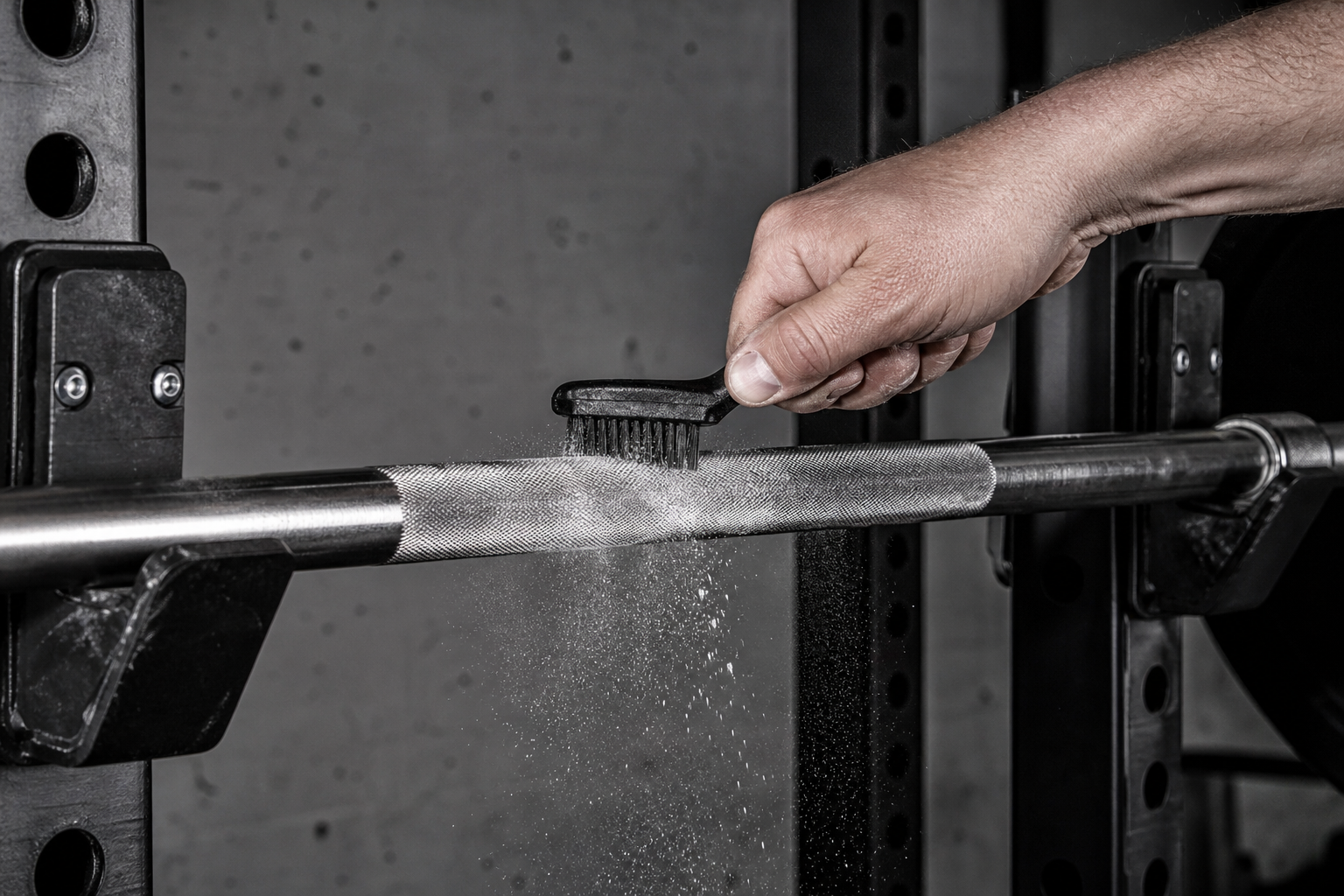
Chalk dries your hands. On the bar, it does the opposite. It packs into the knurl, holds sweat against the steel, and in a humid garage that is where rust starts. American Barbell: “Rust also will form under sealed or caked on chalk.” Chalk the hands, not the bar, and brush the knurl after every session.
Brushes
Match the bristle to the finish.
- Coated bars, meaning Cerakote, zinc, chrome and Duracoat: nylon. Every maker that gives brush advice says so, and American Barbell warns that “cheap steel bristles can alter appearances and contribute to corrosion”.
- Bare steel: Bells of Steel and Texas Power Bars allow a stiffer brush. Nylon still works, with more passes.
- Stainless and hard chrome: American Barbell allows a stainless steel brush. Eleiko keeps steel brushes for its IPF powerlifting competition bars only.
If you own more than one bar, buy nylon and use it on all of them.
REP, Titan and Bells of Steel sell no barbell brush; Bells of Steel sells a microfiber cloth for $4.49. Rogue lists nylon bar brushes and a cleaning kit that pairs a nylon brush with a 3 oz bottle of 3-IN-ONE oil. Prices on Rogue’s store were not confirmed on 25 November. A stiff nylon utility brush from a hardware store does the same job.
Oil
Rogue and REP both name 3-IN-ONE Multi-Purpose Oil. Its maker says it “lubricates moving parts, penetrates rust, and protects tools and equipment”, without stating how long the protection lasts.
How much: less than you think. Rogue’s guide says “a light coat”; its care page adds, “The bar should feel dry, not slick.” A few drops on a cloth, wiped along the shaft and then wiped again with a clean cloth, leaves the film without leaving the bar greasy in your hands.
Which finishes: REP lists oil for Duracoat, chrome, zinc and stainless, and leaves Cerakote off the list. Rogue says stainless and Cerakote usually need only brushing, zinc an occasional light oil, and black oxide frequent oiling. Bare steel needs it most.
Sleeves
Sleeve advice differs by maker more than anything else on this page.
- REP: drip “a minimal amount of 3-in-1 oil” where the sleeve meets the shaft and spin the sleeve for one to two minutes. No disassembly.
- Rogue: stand the bar on end, oil at the same joint, and leave it for “several hours or overnight”. Keep cleaners out: they “can break down the lubricant which can affect spin or lead to corrosion”.
- American Barbell: “DO NOT use anything that is silicone based.”
- Texas Power Bars: contact the company before lubricating the sleeves.
If a sleeve still spins freely, leave it alone.
Storage between sessions
Strip the bar after every session. REP and Eleiko both say not to store it loaded, and Eleiko gives the reason: the bar can bend. American Barbell recommends a horizontal rack so chalk does not fall into the bearings. REP’s warranty excludes damage from dropping a loaded bar onto a box, a bench, spotter arms or rack pins. Our plate storage guide covers trees, horns and bar holders.
A schedule for a garage
| When | What |
|---|---|
| After every session | Nylon brush through the knurl, dry cloth along the bar |
| Weekly in humid months, monthly in dry ones | Full brush, then a light oil film on zinc, black oxide and bare steel |
| Quarterly, at the least | Everything above on every bar, per REP’s minimum |
| When spin slows | Sleeve oil as the maker describes, or a call to the maker |
For the humidity side of this, see rust prevention in an unheated garage.