Titan Fitness Elite Competition Plates (KG)
Titan's Elite Competition Plates in kilos, judged on Titan's own sheet: ±10 g per plate, 450 mm across, 55 mm wide at 20 kg, a one-year warranty. The 140 kg set works out to $4.76 a kilo; the 10 kg pair and the 25 kg single could not be ordered on our check date.
By Dana Whitlock, editor-in-chief
- Sheet checked
- Published
- Updated
Affiliate disclosure The buy link on this page may pay us a commission. Commission never changes a score, a rank or a printed con. Full policy.
Verdict
Titan prints the same ±10 g per plate as the calibrated steel in our roundup, on a rubber disc that costs $6.00 a kilo bought singly and $4.76 in the 140 kg set. The warranty is one year, the shortest stated in the group, and a 20 kg plate is 55 mm wide against Eleiko's 50. On the check date the 10 kg pair and the 25 kg single could not be ordered on their own.
The sheet
Every figure is Titan's, from its product pages on 25 November 2026; the desk did not weigh, measure or drop these plates. Titan states ±10 g per plate, a 450 mm diameter, a 50.6 mm collar opening held to ±0.2 mm, a chrome-plated steel insert and IWF colour coding. The 20 kg plate is 55 mm wide. Warranty is one year. The line is sold as a 10 kg pair, 15, 20 and 25 kg singles, or a 140 kg set. On the check date the 15 and 20 kg singles and the set were in stock, the 10 kg pair was out of stock and the 25 kg single was not offered.
What the maker states
Every figure in this review is Titan’s, read from its product pages on 25 November 2026. The desk did not weigh, measure or drop these plates. The scores at the end judge the sheet and the price, and the last section explains how.
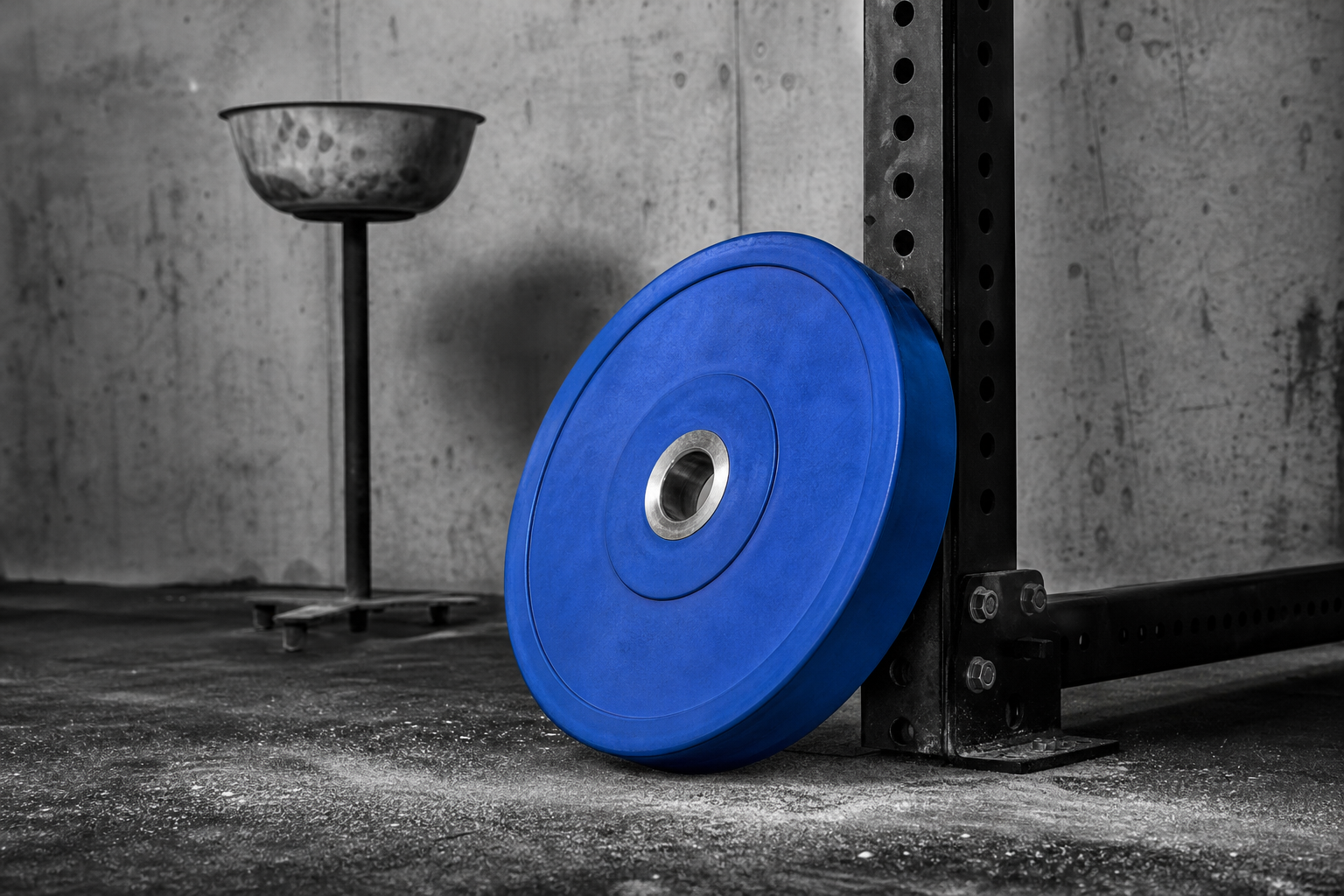
Titan sells the Elite line as competition plates, and the sheet backs the claim on paper. Each plate is stated at ±10 g of its face value. The diameter is 450 mm, the IWF figure. The collar opening is 50.6 mm, and Titan does something most makers skip: it prints a tolerance on the hole as well, ±0.2 mm, so the bore should land between 50.4 and 50.8 mm. The insert is a chrome-plated steel disc, the rubber is described as low-bounce, the colours follow the IWF code, and a raised edge gives fingers something to hold when loading.
Width is published for the 20 kg plate: 55 mm. That is the figure that decides sleeve space, and few bumper makers print it.
The bore tolerance has a practical edge. On a sleeve at its nominal 50 mm, a Titan plate at the bottom of its range has 0.4 mm of clearance, the same as Rogue’s calibrated steel; one at the top has 0.8 mm. Looser plates slide on more easily and can walk along the sleeve between reps, which is what collars are for. Tighter plates go on slower and stay put. Either way, the range is printed, which is more than most bumper sheets offer.
The line is sold in an unusual way. The 10 kg plates come as a pair; the 15, 20 and 25 kg plates come singly; and a 140 kg set bundles a pair of each. On 25 November the 20 kg single was $119.97, down from $129.99, and the 15 kg single $94.97. The 10 kg pair was $189.99. The set was $665.99, listed down from $899.99.
The warranty is one year, with extended coverage offered on the product page.
Titan also sells black change plates in kilos, in pairs from 0.5 to 5 kg; the 2.5 kg pair was $44.97 and the 5 kg pair $80.97, both in stock. They are a separate product with their own page. Check its tolerance before assuming the Elite figure carries over to them.
What to watch
Stock decides the price. Bought as singles, a pair of 20s costs $239.94: $6.00 a kilo. Bought as the 140 kg set, the whole line comes to $4.76 a kilo, close to REP’s pound bumpers at $4.41 and with a tolerance twenty times tighter. But on the check date the set was the only way to get the heavy plates. The 25 kg single was not offered and the 10 kg pair was out of stock. A buyer who wanted to add one pair of 25s to an existing set had no way to do it from Titan that day.
The set price is a sale price. At $665.99 the 140 kg set is $4.76 a kilo. At its $899.99 list it would be $6.43, more than the singles. The value score assumes the reduced price; if it ends, the case for the set ends with it, and the score would fall.
One year. The warranty is the shortest stated among the six lines we compared. Bells of Steel prints a limited lifetime warranty on its competition bumpers, Eleiko ten years, REP three years on its heavier training plates. A rubber disc dropped every session is exactly the kind of product a warranty exists for. Extended coverage is offered; price it into the comparison.
Width against Eleiko. At 55 mm, Titan’s 20 kg plate is 5 mm wider than Eleiko’s 20 kg disc. Five millimetres a plate is 20 mm on a sleeve carrying four 20s: not a crisis, but it adds up on a heavy pull. Titan’s sheet gives the 20 kg width only.
No drop rating. Titan calls the rubber rugged and low-bounce but gives no drop count. Eleiko and REP both publish one. Without it, the one-year warranty is the only stated measure of how long Titan expects the plates to last.
Pounds are a different product. Titan sells an Elite line in pounds as well. This review covers the kilo plates and their ±10 g only; read the pound pages’ own tolerance before assuming it is the same.
Who it is for
Weightlifters who want discs sized and coloured like those on a meet platform, with a gram tolerance printed by the maker and a price on the page. Small clubs fitting out a second platform, for whom the 140 kg set is the natural order. Lifters who want Eleiko-class figures on paper and will accept a one-year warranty to get them at a listed price.
It is the wrong buy for anyone filling gaps in an existing set one plate at a time while the 25 kg single and the 10 kg pair are unavailable. Lifters who never drop the bar would get more load per sleeve from calibrated steel.
The verdict
Titan’s sheet is better than its price suggests: ±10 g, a toleranced bore and a published width, at $4.76 a kilo in the set. These scores are an editorial reading of the sheet and the list price, not test results. Build looks at stated tolerance, materials and warranty, value at the price per kilo against them, and use at sleeve space, drop suitability and what can actually be ordered. The one-year warranty costs build, the stock gaps cost use, and the set price earns the value score. 8.4.
Specs and measurements
| Measure | Value |
|---|---|
| Weight tolerance | ±10 g per plate, stated |
| Diameter | 450 mm, stated |
| Width, 20 kg plate | 55 mm, stated |
| Collar opening | 50.6 mm ±0.2 mm, stated |
| Insert | Chrome-plated steel disc, stated |
| Colour coding | IWF, stated |
| Warranty | 1 year, extended coverage offered, stated |
| How it is sold | 10 kg pair; 15, 20 and 25 kg singles; 140 kg set (a pair of each) |
| Stock, 2026-11-25 | 15 and 20 kg singles and 140 kg set in stock; 10 kg pair out of stock; 25 kg single not offered |
| Prices, 2026-11-25 | 20 kg single $119.97 (list $129.99); 15 kg single $94.97; 10 kg pair $189.99; 140 kg set $665.99 (list $899.99) |
Pros and cons
Pros
- ±10 g per plate stated, on a disc made to be dropped
- $4.76 a kilo in the 140 kg set, $6.00 bought as 20 kg singles
- Width and bore tolerance published: 55 mm at 20 kg, 50.6 mm ±0.2 mm
Cons
- One-year warranty, the shortest stated in our roundup
- 10 kg pair out of stock and 25 kg single not offered on 25 November
- 55 mm wide at 20 kg, 5 mm more than Eleiko's 20 kg disc
How we scored
Figures from the maker sheet and the price page, used on the platform, then loaded against the pass limits we hold all plates to. The scores come from those numbers, not from the box.
- Mass against nominal, mean of three tared weighings Within 0.25% of nominal IPF rules
- Bumper drop test, 500 drops from 1.2 m onto the pit Hub intact, no separation Desk limit
Written by
Editor-in-chief
Twelve years in trade publishing, eight of them running gear desks. Signs every roundup and the corrections log, and decides when a test is finished.
How Dana tests →Spotted a wrong number? Tell the desk. Fixed within two business days and logged on the corrections page.