Concept2 RowErg
Concept2's air rower, logged from the maker's own pages: an aluminum frame, a PM5 monitor on two D cells, a 500 lb user rating by Concept2's own test and 300 lb under EN 20957-7, five years on the frame and two on moving parts and monitor, at $990 plus $55 shipping. Both leg heights were in stock on 25 November 2026. It needs 9 by 4 ft of floor to use and splits in two to store.
By Hannah Kessler, reviews editor
- Sheet checked
- Published
- Updated
Affiliate disclosure The buy link on this page may pay us a commission. Commission never changes a score, a rank or a printed con. Full policy.
Verdict
The rower to buy if you buy one cardio machine. Concept2 states an aluminum frame, five years on it and two on the moving parts and monitor, a 500 lb user rating and a machine that splits in two without tools, at $990 plus $55, in stock with 1 to 3 day dispatch. It needs a 9 by 4 ft patch of floor, and the sheet carries two different user-weight figures.
The sheet
Concept2's sheet is the most complete of any cardio machine on this desk: frame and leg materials, chain material, monitor power, two user-weight ratings, assembled, in-use and stored dimensions, machine and box weights, shipping cost by destination and a warranty split by part. The RowErg costs $990 with standard legs and $1,155 with tall legs, both were available on 25 November 2026, and the warranty is five years on the frame and two on moving parts and the monitor. What the sheet does not settle is why its two user-weight ratings differ by 200 lb, and what it does not hide is the floor it needs.
What the maker states
Everything on this page comes from Concept2’s own documents: the RowErg product page with its specification and shipping tables, and the RowErg warranty page. They went on the bench the same week. No RowErg was on our floor for this review, and none of the figures below is ours.
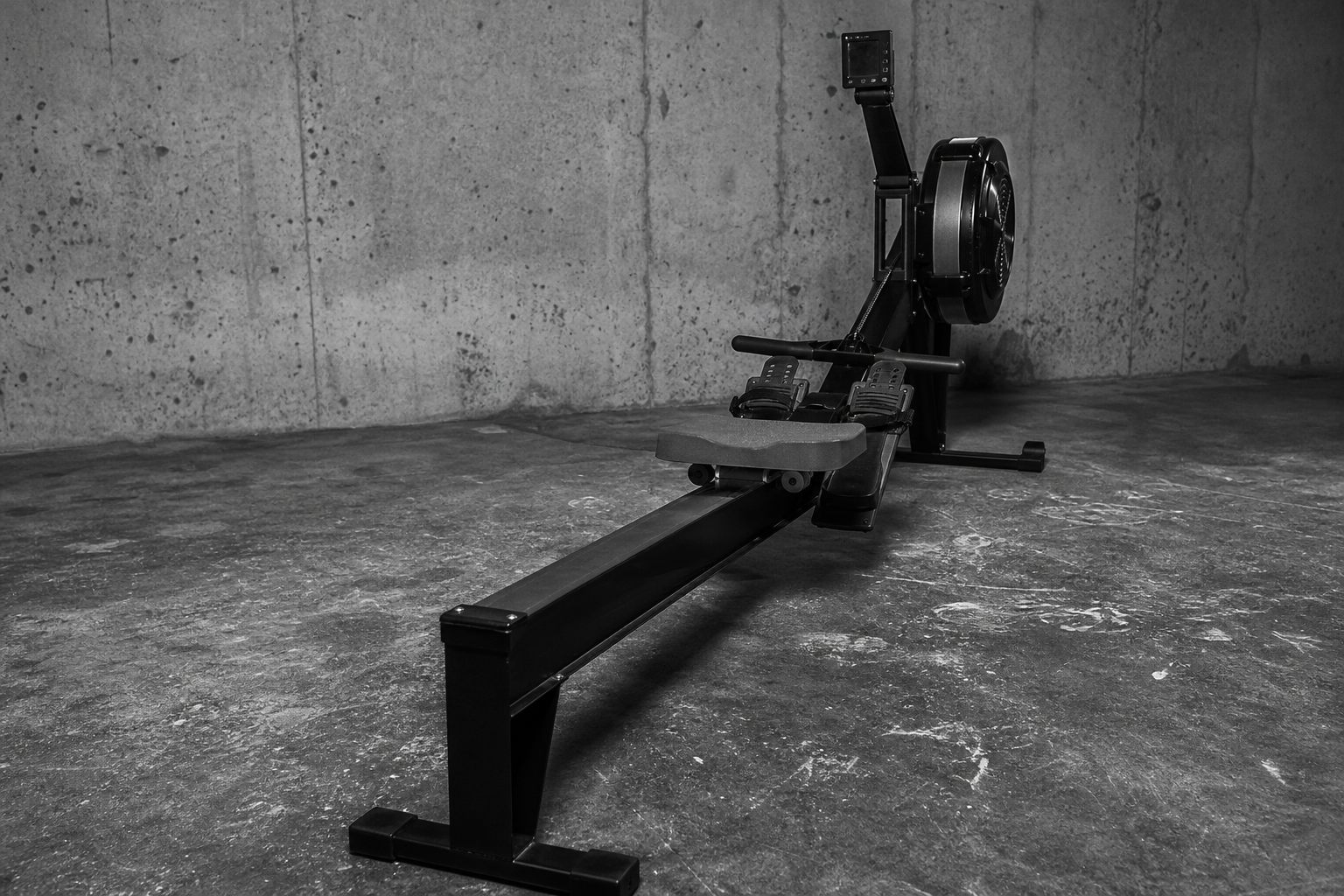
The RowErg is an air rower. The handle pulls a nickel-plated steel chain, the chain spins a flywheel, and the flywheel’s blades push air; the faster you pull, the harder the air pushes back. Concept2 builds the frame in aluminum. With standard legs the front legs are aluminum and the rear legs steel; with tall legs both pairs are steel. A PM5 monitor comes standard. It runs on two D cells and, Concept2 says, draws power from the spinning flywheel during a workout to stretch battery life. There is no plug.
Two versions are sold. Standard legs put the seat 14 in (36 cm) off the floor, weigh 57 lb (26 kg) and cost $990. Tall legs raise the seat to 20 in (51 cm), weigh 68 lb (31 kg) and cost $1,155. Concept2 says the taller frame is for getting on and off more easily, not for taller rowers: both fit inseams up to 38 in (96.5 cm), and anyone with a longer inseam may need an extra-long monorail, ordered by contacting Concept2.
The machine is 96 in long and 24 in wide, and Concept2 asks for 9 by 4 ft of floor once you allow room to row. It separates into two pieces without tools; in two pieces, the standard version stands in 25 by 33 by 54 in. Casters let you roll it.
Maximum user weight is printed twice: 500 lb (227 kg) “as tested by Concept2”, and 300 lb (135 kg) as tested under EN 20957-7, the European standard for stationary rowing equipment.
Prices and stock on the check date: both versions showed as available, and Concept2 says orders typically ship within 1 to 3 business days. Ground shipping to the lower 48 is $55 for the standard version, one 68 lb box, and $85 for tall legs, two boxes. Five or more Concept2 machines on one order drop the RowErg to $940 each.
Warranty, from Concept2’s warranty page: a limited five years on frame parts and two years on moving parts and the monitor, from the date of purchase from Concept2. A 30-day money-back offer applies to factory-direct sales in the US and Canada, counted from shipment, with all shipping costs on the buyer.
What to watch
Two user-weight figures. 500 lb is Concept2’s own test; 300 lb is the figure under EN 20957-7. The page does not describe Concept2’s method or explain the 200 lb gap. Most lifters sit under both. If you weigh more than 300 lb, the higher rating rests on a test the page does not show, so put the question to Concept2 in writing before you order.
It is long. At 96 in assembled and 9 by 4 ft in use, the RowErg takes more floor than any bike or ski machine in our cardio machine roundup. A one-car garage holding a rack and a platform may not have a clear 9 ft run left. Splitting it and standing the halves on end helps between sessions; it does not shorten the machine while you row.
Steel where it moves. The frame is aluminum, which does not rust, but the chain is nickel-plated steel and the standard version’s rear legs are steel. Concept2 calls the machine easy to care for and does not say on the product page how often the chain wants oil; the user manual does. In a humid garage, plated steel corrodes where the plating wears, so wipe the chain after sessions and keep it oiled.
The return is not free. Thirty days to change your mind is a fair offer, but the box costs $55 to send out, and on a return every shipping cost is the buyer’s. Budget for both legs of the trip if you are unsure about the stroke.
Tall legs cost $165 more. That buys a seat 6 in higher and 11 lb more steel. Concept2’s own advice is that height alone is not a reason to need it; knees, hips and mobility are.
Who it is for
Anyone who has room for one cardio machine and wants the one whose numbers mean the same thing from one session to the next. The same PM5 sits on the RowErg, the BikeErg and the SkiErg, and Concept2 says it self-calibrates, so a lifter who later adds a second Concept2 machine reads both on one monitor. The stroke works legs, trunk and arms together, and Concept2 describes it as low impact, which suits lifters who want conditioning that does not add pounding to knees already busy with squats.
At $990 plus $55 it is not the cheapest air machine in our roundup. The AssaultBike Classic is $749 delivered. The RowErg carries the same five-year frame term, and it was in stock while every Assault machine we checked was sold out.
It is not for a narrow garage. If you have a 6 ft wall and nothing else, the SkiErg, which hangs 16 in off a wall, or a fan bike at 45 to 55 in long will fit better. For the bikes, read our Rogue Echo vs Assault AirBike comparison.
The verdict
Nine point two. Build scores the stated load rating, the nearest thing a cardio machine has to a tolerance, along with the material and the warranty, and value scores the price per year of warranty cover against that build. Use scores practicality and stock on the day we checked prices; every figure comes from Concept2’s own pages, so these scores rank documents, not rowers on our floor.
Build gets 9.3: an aluminum frame, five years on it, two years on moving parts and the monitor, and a 500 lb rating, held back by a second rating of 300 lb that the page does not reconcile. Value gets 8.9: $990 is $198 per year of frame cover, against $149.80 for the AssaultBike Classic and $472.50 for the Rogue Echo Bike at list, and Concept2 adds $55 shipping where Assault charges none. Use gets 9.4: both versions in stock, 1 to 3 day dispatch, no plug, 57 lb, and two pieces without tools, marked down for the 9 by 4 ft it needs.
The safest single cardio purchase on this desk. Measure the garage first.
Specs and measurements
| Measure | Value |
|---|---|
| Resistance | Air, from a flywheel, stated |
| Frame | Aluminum; standard legs aluminum front and steel rear, tall legs steel front and rear, stated |
| Chain | Nickel-plated steel, stated |
| Monitor and power | PM5 on two D cells, assisted by the flywheel during use, stated |
| Maximum user weight | 500 lb (227 kg) as tested by Concept2; 300 lb (135 kg) under EN 20957-7, stated |
| Machine weight | 57 lb (26 kg) standard legs, 68 lb (31 kg) tall legs, stated |
| Dimensions | 96 x 24 in assembled; 9 x 4 ft with clearance for use, stated |
| Seat height | 14 in (36 cm) standard, 20 in (51 cm) tall legs; inseams up to 38 in (96.5 cm), stated |
| Storage | Two pieces, no tools; 25 x 33 x 54 in with standard legs, stated |
| Warranty | Limited: 5 years on frame parts, 2 years on moving parts and monitor; 30-day money-back, buyer pays shipping |
| Price per year of frame cover | $198 at $990 |
| Stock | Both versions available; ships in 1 to 3 business days; checked 2026-11-25 |
Pros and cons
Pros
- Five-year frame warranty, two years on moving parts and the monitor
- Both versions in stock, dispatched in 1 to 3 business days
- 57 lb, and splits into two pieces without tools
- No socket: the PM5 runs on two D cells, helped by the flywheel
Cons
- 96 in long assembled and 9 by 4 ft in use
- Two user-weight ratings, 500 lb by Concept2's test and 300 lb under EN 20957-7
- $55 shipping on top; a 30-day return leaves all shipping to the buyer
How we scored
The unit went through the timed pass and the price was checked against the seller, then scored against the limits we hold all conditioning to. The scores come from those numbers, not from the box.
- Displayed power against the load cell at 150 W and 300 W ± 5% Desk limit
- Frame at 1.5 times rated user weight for 60 s No permanent set ASTM F2571
- Noise at 1 m, 300 W steady state ≤ 80 dB(A) Desk limit
Written by
Reviews editor
Runs the shortlist process, vendor contact and returns. Every unit that leaves the floor goes through her spreadsheet first.
How Hannah tests →Spotted a wrong number? Tell the desk. Fixed within two business days and logged on the corrections page.